
 Machine Learning-enabled Identification of Archaeological Objects in the Middle Danube River Basin
The project LEGION (machine LEarninG-enabled Identification of archaeological Objects in the middle daNube river basin) is developing an innovative AI-based method for the automated classification and analysis of Roman common ware pottery from the UNESCO World Heritage site Carnuntum. The aim is to enable faster and more sustainable analysis of archaeological finds—offering new perspectives on Roman provincial history and material culture.
LEGION builds on a unique dataset of approximately 70,000 2D profile drawings of pottery vessels, collected over several decades of archaeological fieldwork. These are enriched with detailed archaeological attributes (form, manufacturing, decoration, chronology, fragment type). The project integrates cutting-edge Machine Learning (ML) techniques, Explainable AI (XAI), and Human-in-the-loop (HITL) approaches. The result will be a scalable, transparent typochronology, enabling reproducible analyses and providing new insights into production and distribution systems.
LEGION thus provides a practical solution for the classification of large assemblages of finds based on well-established 2D documentation standards—a major innovation boost for Heritage Science (HS). The project deliberately avoids complex and expensive 3D methods to facilitate application in both everyday archaeological practice and commercial archaeology.
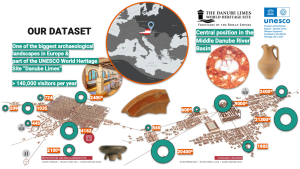
In addition to classification, LEGION offers new insights into settlement dynamics: the distribution of pottery types will allow the reconstruction of phases of growth, crisis, and decline in Carnuntum’s urban history. Using an interdisciplinary approach, the typochronology will also support the analysis of socio-economic and demographic processes. The resulting data will enable new understandings of trade networks, production centers, and cultural identities within the Roman province.
All data, ML models, and tools will be made openly and sustainably available in line with FAIR and CARE principles and integrated into European research infrastructures, including E-RIHS. LEGION thus enhances Austria’s visibility and expertise in international Heritage Science and provides a reusable digital infrastructure applicable to other regions and periods (e.g. the Middle Ages).
In close collaboration between the Austrian Archaeological Institute of the Austrian Academy of Sciences (ÖAW), the Computer Vision Lab at TU Wien, the Lower Austrian State Collections, the ACDH-CH, and further partners, LEGION is developing a cutting-edge tool for academic research, heritage management, and cultural heritage. Supported by an active science communication strategy (including social media, exhibitions at Römerstadt Carnuntum, and online articles), LEGION also promotes digital literacy, AI literacy, and greater awareness of AI applications in Heritage Science.
Publications
- G.V. Naghavi, D. Hagmann, M. Kampel, I. Ballester (2026). “OCR-Based Field Extraction for Archaeological Pottery Metadata: The CENTURIA Dataset”, VISART Workshop, ECCV 2026. (BEST PAPER AWARD) https://arxiv.org/abs/2608.30616
Partners
Lead Institutions
- Austrian Archaeological Institute (ÖAI/ÖAW). PI: Dominik Hagmann; Co-PI: Silvia Radbauer
- Computer Vision Lab (CVL/TU Wien). Co-PIs: Martin Kampel, Sebastian Zambanini, Irene Ballester Campos
Key Collaborators
- Lower Austrian State’s Collections & University for Continuing Education Krems
- Archaeological Park Carnuntum
- ACDH (ARCHE)
- Vienna Museum
Funding
LEGION is funded by the Heritage Science Austria 2.0 program under the program responsibility of the Austrian Academy of Sciences (ÖAW)