
Master Thesis
Status: closed
Supervisors: Martin Kampel, Irene Ballester
Build AI for Archaeological Discovery at a UNESCO World Heritage Site
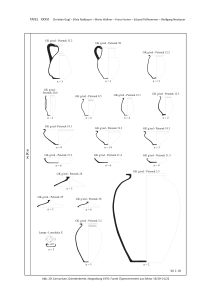
Work with real data from Roman Carnuntum (70,000+ pottery drawings) to create classification tools that archaeologists will actually use. Your work will contribute to ongoing Heritage Science research in Austria.
Context
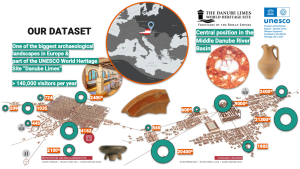
This thesis tackles a real-world archaeological challenge in collaboration with the Austrian Archaeological Institute (ÖAI) and Archaeological Park Carnuntum. You’ll develop computational methods to analyze a large collection of Roman pottery drawings from Carnuntum, one of the most important Roman sites along the Danube frontier (1st-4th century CE). Archaeological pottery drawings present unique challenges: varying quality, heterogeneous styles, and diverse preservation states. You’ll work on: (1) preprocessing using domain-specific tools, (2) learning meaningful feature representations, and (3) clustering to discover coherent pottery groupings.
This work connects to the LEGION Heritage Science project, a collaboration between TU Wien’s Computer Vision Lab and the Austrian Archaeological Institute. Your methods and findings could directly inform tools used by researchers across Europe.
Tasks
- Literature review: computer vision for technical drawings andarchaeological artifacts, feature learning, clustering methods
- Implement and evaluate PyPotteryLens preprocessing tool; adapt for dataset-specific challenges
- Investigate and compare feature extraction approaches (pre-trained models, self-supervised learning, domain-specific methods)
- Implement and compare clustering algorithms
- Evaluate clustering quality through quantitative metrics and visual analysis
- Optional: explore integration of archaeological metadata (chronology, context, measurements…)
- Document methodology, experiments, and results
Deliverables
- Master thesis
- Documented and clean code repository (preprocessing, feature extraction, clustering)
- Preprocessed dataset with extracted features and cluster assignments
Are You a Good Fit?
- Strong Python programming skills (PyTorch)
- Background in computer vision/machine learning (or eager to learn)
- Independent and systematic working style
- Excited about interdisciplinary research and real-world impact
What to expect
- Duration: typically 6-8 months full-time, flexible based on availability
- Weekly meetings to discuss progress and next steps (online or in-person)
- Optional participation in project meetings with archaeologists and site visits to Carnuntum
- Opportunity to contribute to research publications
Contact
Irene Ballester (irene.ballester@tuwien.ac.at)
Martin Kampel (martin.kampel@tuwien.ac.at)